 View of Armada Way, from the top af the Civic Centre, the highest place in Plymouth. The city looks so different, the people like ants all busy wandering about, the shops like toy buildings and the shop entrances are hardly visable
Sunday
Armada Way
View of Armada Way, from the top af the Civic Centre, the highest place in Plymouth. The city looks so different, the people like ants all busy wandering about, the shops like toy buildings and the shop entrances are hardly visable

Friday
Airborne camera
When man was at last able to ascend into the air, he marvelled at the sight of the land stretched endlessly below him. The “Birds eye view” came into being the moment perspective was a concern of western man, and Columbus sailed towards the ever distant vanishing point.
Frenchman Aurther Batut was a pioneer in this kite or (Aerial) photography. He built a kite which he modified to carry a camera and he used a home made box camera with a guillotine shutter to take pictures with. In 1851 Batut discovered that detailed acurate maps and ground plans could be made by taking two or more aerial photos and reversing the rules of perspective.
The German army experimented with rocket photography and in 1888 the magazine La Nature described the photo rocket. In 1891 a patent was issued to German Ludwig Rahnmann for a large calibre gun or rocket photographic system. A pigeon camera was also patented in Germany in 1903 this consisted of the pigeon having a harness fitted to him, this harness had a miniture camera attached to it.
Batut was inspired by Tissanders book on balloon photography although balloon photographs were rarely accepted as landscape.
Uses of aerial photographs include: - making accurate maps, finding disturbances in soil = archaeological sites, geography = untract terrain, civil engineering, city planning, forestry commission, traffic engineers and geologists, concervation work, as well as tax collection (land ownership). (Newhall: 1969)
Newhall. B. (1969). Airborne Camera. London: Focal Press Ltd.
Base Jumping
In 1975, Owen J. Quinn, a jobless man parachuted from the south tower of the World Trade Centre to publicise the plight of unemployment. Quinn got a job with the dock builders' union, working at the World Trade Centre and on July 22, he disguised himself as a construction worker, hid his parachute in a duffel bag and made his way up the North Tower of the World Trade Centre. He claims to have been inspired after seeing a modle of the WTC. Quinn had long ago had his first taste of parachuting and absolutely loved it and wanted to die doing it. Quinn wore a blue football jersey with the biblical verse, a19:26: "But Jesus beheld them and said unto them, with men this is impossible, but with God all things are possible". When he landed he was arrested. He was booked and charged with trespassing, disorderly conduct, and reckless endangerment. (Base Jumping: 2011)
In 1976 Rick Sylvester skied off Canada's Mount Asgard for the ski chase sequence of the James Bond movie The Spy Who Loved Me, giving the wider world its first look at BASE jumping.
Base Jumping.(2011). [online]. Jumping Off A Cliff, AVAILABLE at: : http://en.wikipedia.org/wiki/BASE_jumping [ACCESSED ON 24-3-2011]
Thursday
Franz Reichelt
(1879 – February 4, 1912)
An Austrian-born French tailor, inventor and parachuting pioneer, sometimes referred to as the Flying Tailor, he is remembered for his accidental death by jumping from the Eiffel Tower while testing a wearable parachute of his own design. Despite attempts by friends and spectators to dissuade him, he jumped from the first platform of the tower wearing his invention. The parachute failed to deploy and he crashed into the ground at the foot of the tower. The next day, newspapers were full of the story.
An Austrian-born French tailor, inventor and parachuting pioneer, sometimes referred to as the Flying Tailor, he is remembered for his accidental death by jumping from the Eiffel Tower while testing a wearable parachute of his own design. Despite attempts by friends and spectators to dissuade him, he jumped from the first platform of the tower wearing his invention. The parachute failed to deploy and he crashed into the ground at the foot of the tower. The next day, newspapers were full of the story.
Franz Reichelt said "I want to try the experiment myself and without trickery, as I intend to prove the worth of my invention". (Je veux tenter l’expérience moi-même et sans chiqué [sic], car je tiens à bien prouver la valeur de mon invention.)

Wikipidia. [online]Available at: http://en.wikipedia.org/wiki/Franz_Reichelt (Accessed on 24-3-2011).
Friday
History of maps
What is a map ? - A map is a graphic representation or scale model of spatial concepts. It is a means for conveying geographic information. Incorporated in a map is the understanding that it is a "snapshot" of an idea.
A map can display only a few selected features, which are portrayed usually in highly symbolic styles according to some kind of classification scheme. In these ways, all maps are estimations, generalizations, and interpretations of true geographic conditions. Maps of all kinds are fundamentally important for modern society.
Modern maps:- much of the world was poorly known until the widespread use of aerial photography following World War I. Modern cartography is based on a combination of ground observations and remote sensing.
J.S. Aber (2008) Brief History of Maps and Cartography. [Online] Available at: http://academic.emporia.edu/aberjame/map/h_map/h_map.htm. [Accessed on 18-3-2011]
Maps byArtists
Maps are an increasingly common feature of artistic practice in this information addicted early 21st century, as both representations of real places and diagrams of intangible things, whether movement, data, networks or imaginary realms. Any of these works represent maps that exist in people’s mind.
The exception is Simon Clarke’s Geographically Accurate Tube Map, which shows the actual shape of the underground system
Icon Magazine. (Issue 040 October 2006).Maps by Artists. Online [Available at] http://www.iconeye.com/index.php?option=com_content&view=article&id=2906 [Accessed on 18/3/2011]
Thursday
Satellite Images of the town of Rikuzentakata, Japan, before and after the devastation March 2011


 Available at: http://www.bbc.co.uk/news/world-asia-pacific-12743904
[Accessed on 16/03/11]
Monday
flying high

This is my one and only time of gliding like a bird.
The feeling I had when doing this was terrific, it gave me a great sense of freedom.
What was amazing was how safe I felt.
I was so excited as I looked down at the people below on the beach, the view was so different from up here, I could see forever.
Saturday
View from the Holiday Inn
 I went to the restaurant in the Holiday Inn ( on the top floor) the view was amazing. I could see Drakes Island and Torpoint, the buildings all looked so small and I could see all the different angles and colours of the rooftops. When looking from the window I saw the roofs of the buildings way into the distance. The buildings looked as if they were top heavy, the roofs so big and the windows and doors so small. The greens looked as if they were plans on paper, the trees like bushes
It was a clear day and not very cold, only February, so good at the end of what I feel has been a long winter.
Friday
From Dingles
The view from the top floor of The House Of Fraser.
The tops of the buildings look grubby and in need of a clean. The roof of the building looks very different from up here. It reminded me of being a child where I used to climb onto my school rooftop, and makes me think it would be good fun to scramble about on top of this roof.
The shop fronts could be anywhere in the country, they don't have much of an identity.

The tops of the buildings look grubby and in need of a clean. The roof of the building looks very different from up here. It reminded me of being a child where I used to climb onto my school rooftop, and makes me think it would be good fun to scramble about on top of this roof.
The shop fronts could be anywhere in the country, they don't have much of an identity.

Monday
Notes On Scott Haefner.
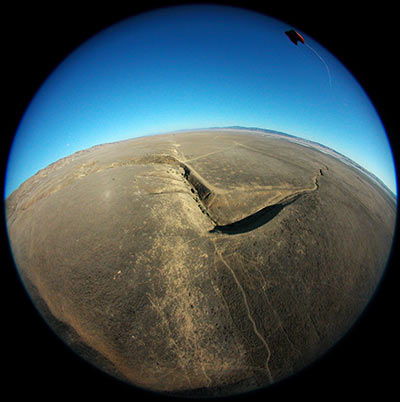
Kite photography, invented in the 1870s—flourished until the 1920s, when airplane photography took over. In France, pioneering photographers created aerial panoramas.
George Lawrence sent a camera skyward to record the destruction from the 1906 San Francisco quake.
Kite photography was reborn in the 1980s. Today it’s booming, with several hundred practitioners worldwide and as many Web sites. Haefner knows half a dozen fellow enthusiasts.
It is virtual reality and psychedelia all in one, as the world spins about with ever-changing distortions.
Haefner creates bubble panoramas, using a fish-eye lens to take one shot looking straight up and another shot from the kite straight down, then stitching them together using several software programs and a process developed by French engineer and Lego master Philippe Hurbain.
“...it is virtual reality in the sense that you’re able to get inside this image and rotate it around,” Haefner says. “You’re in control. It’s almost like you’re on this ride where you’re suspended in the air and you can turn and look in any direction you want.”
A remote control box the size of a lunch box lets him aim and shoot.
Weinstein, D . 2003. On Scott Haefner: San Francisco Chronicle [online] July 11 [Available at]
http://scotthaefner.com/publications/chronicle/’: [accessed on 28th January 2011 at 23 30.]
DVD REVIEWS: VERTIGO


Alfred Hitchcock’s 1958 Physiological Thriller.
During a police chase across the rooftops of San Francisco Detective John "Scottie" Ferguson almost falls and discovers his fear of heights. His partner tries to save him, slips and falls to his death.
This opening seen of the film made me feel quite nervous, as it showed ‘scottie’ looking down the length of the building which showed how high he was.
Vertigo. 1958. [DVD] Directed by Alfred Hitchcock. USA: Universal Studios.
Sunday
DVD REVIEW; MAN ON WIRE

FILM IS THE STORY OF PHILIPPE PETIT. WHEN HE WAS A YOUNG MAN IN FRANCE HE SAW AN ARTICAL IN A MAGAZINE ANNOUNCING THE PLANNED BUILDING OF THE TWIN TOWERS IN AMERICA. THE THOUGHT OF THE TOWERS BEING BUILT CAUSED HIM GREAT EXCITEMENT AND HE STARTED MAKING PLANS.
PETIT IS A TIGHT ROPE WALKER, HIS PLAN WAS TO WALK A TIGHT ROPE PLACED BETWEEN THE TOP OF THE TWIN TOWERS.
THE FILM IS A DOCUMENTORY, IS FULL OF TENSION AND VERY GRIPING, THE FILM HAD ME WRIGGLING IN MY SEAT AT THE THOUGHT OF WHAT WAS BEING PLANNED. I COULD FEEL THE TENSION, THE SHEER EXILERATION AND THE SHEAR JOY I FELT WHEN WATCHING HIM ON THE WIRE WAS JUST AMAZING.
MAN ON WIRE. 1974. [DVD] DIRECTED BY JAMES MARSH. ICON FIIM
Quotes by PhilippPetit.
If I die, what a beautiful death! (Philippe Petit)
It's impossible, that's sure. So let's start working (Philippe Petit)
Quotes from man on wire. [available at http://www.imdb.com/title/tt1155592/quotes accessed on 24-5-2011].
Kite Flying
 After looking at Scott Heafner's work I was inspired and decided it was time I tried to fly a kite. Trying to fly my kite made me realise how difficult it is to do what Scott Heafner and lots of other people do for the sake of a "birds eye view".
I found it difficult to get and keep the kite in the air for any length of time. To think that to put a camera in the air adds weight and instability to the kite and it often takes more than one kite. The camera then need to be aimed and fired.
Friday
Olivio Barbieri

In the mid-1980s, Olivo Barbieri travelled to Brittainy, in the north of France, to photograph some of Europe’s oldest manmade structures; towering stones that were shaped and placed on end, these enormous stones stand three to six meters high. It takes only imagination to see these megaliths as the ancestors of the soaring buildings of today. He started out using classical photography and to attempt to describe the world objectively. Barbieri`s expressive approach to night time colour photography brought unexpected life to the scenes. His photographs intensify the unreality that is often encountered in the global cities of the present day. He turned two photographic "mistakes" into signature expressive devices. In the early 1990’s he exploited the technical peculiarity that photographic film "sees" the color temperature of artificial light in ways that do not correspond to human vision. In the late 1990s, he began to experiment with a special tilt-shift lens. Photographs of actual city scenes look like images of miniaturized architectural models. Today there are city’s that are like models.
Phillips,C. (2006) Unreal Cities. [online] Available at: http://artaction.org/proposition/catalogue/detail_cat.php?codeoeuvre=S1377&lang=en&qui=prod&oeuvre=S1377>[Accessed on 20th January 2011: 14:40]
Thursday
summary
Trying to obtain this view inspired some ingenious inventions, such as sending cameras up into the sky attached to free balloons, kites and even attaching them to pigeons. Some inventions sound pretty dangerous like using large calibre guns or rocket photographic systems. Arthur Batut a Frenchman was a pioneer of Arial photography; he made a kite that could carry his home made camera on which he had invented a shutter that he could operate from the ground. (Newhall: 1969). There was also a French taylor called Franz Reichelt, who made himself a wearable parachute. He unfortunately killed himself by jumping from the first platform of the Eiffel Tower on February 4th 1912. When testing the suit, he said “I want to try the experiment myself and without trickery, as I intend to prove the worth of my invention”. (Je veux tenter l’expérience moi-même et sans chiqué [sic], car je tiens à bien prouver la valeur de mon invention.) (Franz Reichelt) (Wikipedia 2011).
Kite photography was the most used way of obtaining a ‘bird’s eye view’ (even though these views were seldom accepted as a landscape) from the 1870’s until the 1920’s when aeroplanes became more widely used for aerial photography. However, kite photography came back into fashion in the 1980’s, thanks to new high-performance kites, and is practiced today by an increasing number of photographers. Most kite photographers do it for fun. A few, including earth scientists and geologists, incorporate it into their studies. Scott Haefner, an environmental scientist does both. He attaches the camera to the line of the kite, and has a remote control box which lets him aim and shoot the camera. Haefner says. “You have got to be inventive and be willing to spend the time building the rig.” (Weinstein: 2003)
The bird’s eye view is so spectacular there is nothing that people will not do to acquire the feeling of freedom and exhilaration that it gives. Some people even try to make them selves fly like kites, by doing such activities as power gliding, hand gliding and the most recent and the most dangerous sport of all, base jumping. The base jumper launches himself from the highest building or cliffs he can find, and with the aid of a parachute glides to the ground. I myself tried power gliding and found it the most exhilarating thing I have ever done, the view below was just incredible and I felt very safe which was surprising as I am usually very nervous of heights.
Photographers such as Marilyn Bridges and Scott Haefner both have a scientific basis to take aerial photographs. But this is not the only motivation for them. Bridges likes the thrill of flying and Haefner does it for pure fun. Whereas photographic artists Olivo Barbieri, Andreas Gursky and William Garnet, take aerial photographs for there artistic practise and sheer pleasure of obtaining the photograph they will only acquire from the air.
Subscribe to:
Posts (Atom)